
By PathGene Biotech · Technically reviewed by Alex Huang
D-Chiro-Inositol vs Myo-Inositol: From the 40:1 Ratio to Ingredient Selection
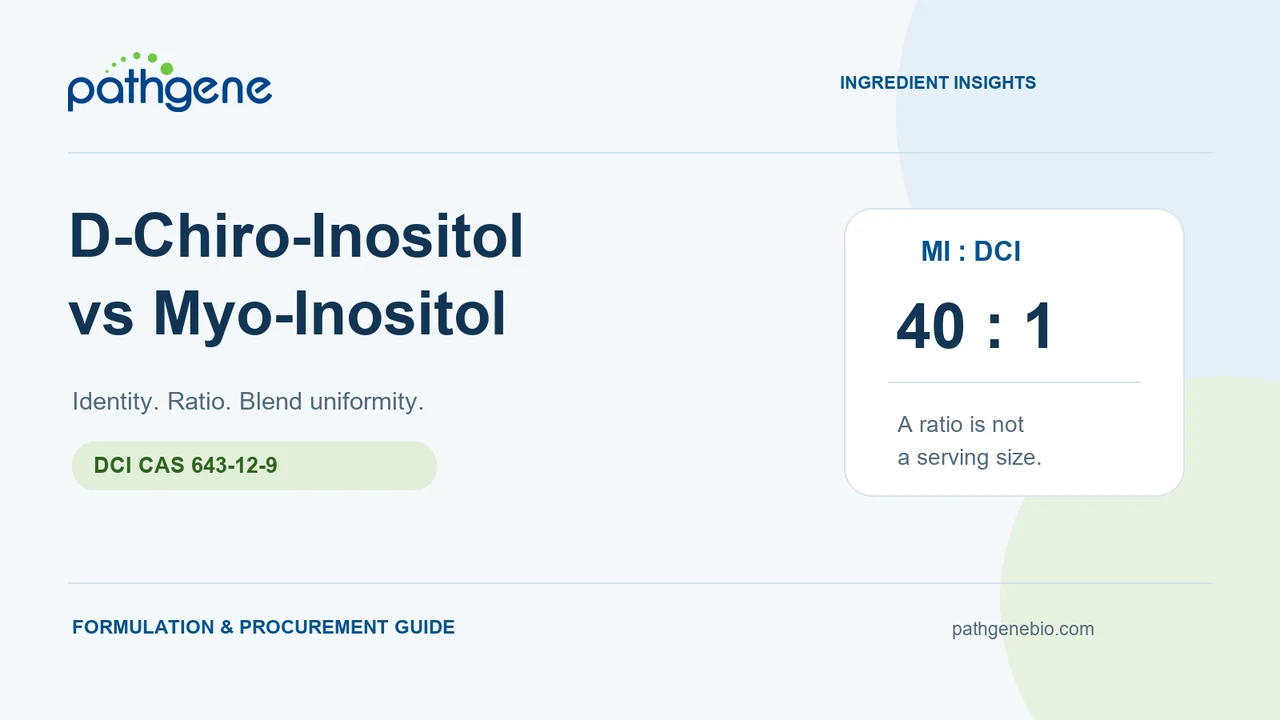
An inositol project may involve myo-inositol, D-chiro-inositol, DCI and a “40:1 blend.” These descriptions answer different questions. Some identify a chemical ingredient, one specifies a relative amount, and “inositol” alone may describe only a broad category.
D-chiro-inositol (DCI) and myo-inositol (MI) are different stereoisomers. A shared molecular formula or total-inositol result does not make them interchangeable. Development requires separate control of ingredient identity, individual content, actual ratio and finished-product uniformity.
MI, DCI and total inositol
| Description | What it establishes | What still needs checking |
|---|---|---|
| Myo-inositol / MI | A specified inositol stereoisomer | Identity, assay method and batch |
| D-chiro-inositol / DCI | D-chiro-inositol, CAS 643-12-9 | Identification, assay and stereochemical controls |
| MI:DCI = 40:1 | A relative mass relationship | Total quantity, raw-weight or active-content basis, and individual assays |
| Total inositol | A possible combined value | Whether MI and DCI were separately measured and the ratio verified |
A total-inositol result may not establish that both components meet their targets. When DCI is present at a lower proportion, an acceptable total can conceal an individual-content or distribution problem.
What does human research contribute?
Standalone DCI research
A 1999 placebo-controlled trial studied 44 obese women with PCOS, evaluating insulin responses, hormones and ovulation. It provides research in a defined clinical population, rather than evidence that a particular bulk ingredient benefits all women. Original study
Combination research and the 40:1 ratio
A 2019 trial compared seven MI/DCI formulations, with eight participants per group, and reported results favoring 40:1 under its study conditions. It offers a ratio-comparison lead, but the small study does not establish a universal optimum. Original study
The 2023 international PCOS guideline states that evidence is insufficient to recommend specific inositol types, doses or combinations. 40:1 is a literature-informed research direction, not a universally guideline-endorsed formula. Guideline, section 4.7
Use the literature to define the intended population, formula and evaluation endpoints. Disease, fertility or clinical-population claims require their own professional and market-specific review; purchasing documentation cannot replace that assessment.
Calculate the ratio before choosing the format
MI:DCI = 40:1 means 40 parts MI to one part DCI, making 41 parts altogether. It does not mean 40% MI plus 1% DCI, and it does not specify an amount per serving.
For a purely mathematical engineering example, suppose a pilot requires 1,000 g of combined active MI and DCI:
| Component | Calculation | Theoretical active-component weight |
|---|---|---|
| MI | 1,000 × 40/41 | 975.61 g |
| DCI | 1,000 × 1/41 | 24.39 g |
| Total | 975.61 + 24.39 | 1,000.00 g |
This is neither an intake recommendation nor a complete drink-mix recipe containing flavors and carriers. Calculate actual ingredient weights from the individual as-supplied mass assays. Align dry-basis results with water content where relevant. An area-purity percentage should not automatically be used as a mass assay for correcting input.
Adding other ingredients lowers the proportion of both inositols in the finished powder without necessarily changing their mutual ratio. Document both MI:DCI and the individual component weights per finished-product unit.
Give the lower-proportion component its own mixing strategy
In the two-component example, DCI represents approximately 2.44%; other ingredients may reduce its final proportion further. A visually uniform powder is not enough to establish its distribution.
One development route is to premix DCI with a portion of the major powder component, then add the remainder in stages. This is a strategy to test, not a guarantee that a fixed mixing time or any equipment will work. Compare samples:
- At different positions after mixing.
- After transfer or intermediate holding.
- At the beginning, middle and end of filling.
- After storage, including individual component content and reconstitution behavior.
If folate or another low-proportion ingredient is included, give it an appropriate premixing and analytical plan. Adding it creates a new development candidate; MI/DCI research alone does not establish the new combination's efficacy.
Capsules, tablets or drink mixes?
| Format | First development question | Informative checks |
|---|---|---|
| Capsule | Can the total formula fit the intended capsule capacity? | Separate MI/DCI content, fill weight and uniformity |
| Tablet | Are tablet weight, compression and disintegration appropriate? | Individual content, disintegration and storage changes |
| Drink mix or stick pack | Can the target mass be mixed consistently and consumed acceptably? | Individual content, segregation, reconstitution and sensory properties |
Water solubility alone does not select a format. A powder may be convenient for piloting a higher-total-weight formula. A capsule project should first calculate actual fill requirements and the intended number of units, then consider user experience. The formula and testing determine suitability.
Qualify DCI content and stereochemistry separately
Review the purchasing name and CAS, identification, assay method, optical-rotation information, water or loss on drying, and batch COA. Read rotation results with their concentration, solvent and other specified conditions. An isolated rotation value should not be relabeled as a specific enantiomeric-purity measurement.
PathGene supplies D-chiro-inositol powder, CAS 643-12-9, with HPLC assay and optical-rotation information on the product page, batch COA and evaluation samples. Establish DCI and MI identity and content separately before piloting a chosen ratio. For analytical terminology, see HPLC Purity vs Assay.
References
- Nestler JE, et al. Ovulatory and metabolic effects of D-chiro-inositol in the polycystic ovary syndrome. New England Journal of Medicine. 1999;340:1314–1320. PubMed. DOI: 10.1056/NEJM199904293401703.
- Nordio M, Basciani S, Camajani E. Seven-ratio MI/DCI comparison study. European Review for Medical and Pharmacological Sciences. 2019;23:5512–5521. PubMed. DOI: 10.26355/eurrev_201906_18223.
- Teede HJ, et al. Recommendations from the 2023 International Evidence-based Guideline for the Assessment and Management of Polycystic Ovary Syndrome. Full guideline, section 4.7.
Frequently Asked Questions
Is D-chiro-inositol the same as ordinary inositol?+
The description is insufficient. DCI and MI are different stereoisomers. Specify the exact ingredient on purchasing documents and COAs rather than using inositol as the only identity information.
Is 40:1 the officially recommended best ratio?+
No. It has a specific research background, but the 2023 international guideline did not recommend a particular type, dose or combination. Consider the intended project and evidence scope without making a universal efficacy claim.
Does an acceptable total-inositol result verify the MI:DCI ratio?+
Not necessarily. Ratio verification needs methods and sampling that can assess the two components separately, especially the lower-proportion ingredient.
Can a 40:1 formula be calculated directly from powder weights?+
That describes a raw-material weight ratio if explicitly intended. For an active-component ratio, calculate using the individual mass assays on an aligned as-supplied basis.
Ready to evaluate our products?
Request a sample or send an inquiry — our R&D team responds within 24 hours.