
By PathGene Biotech · Technically reviewed by Alex Huang
Alpha-Glucosyl Hesperidin for Beverages: Solubility, Research and Sourcing
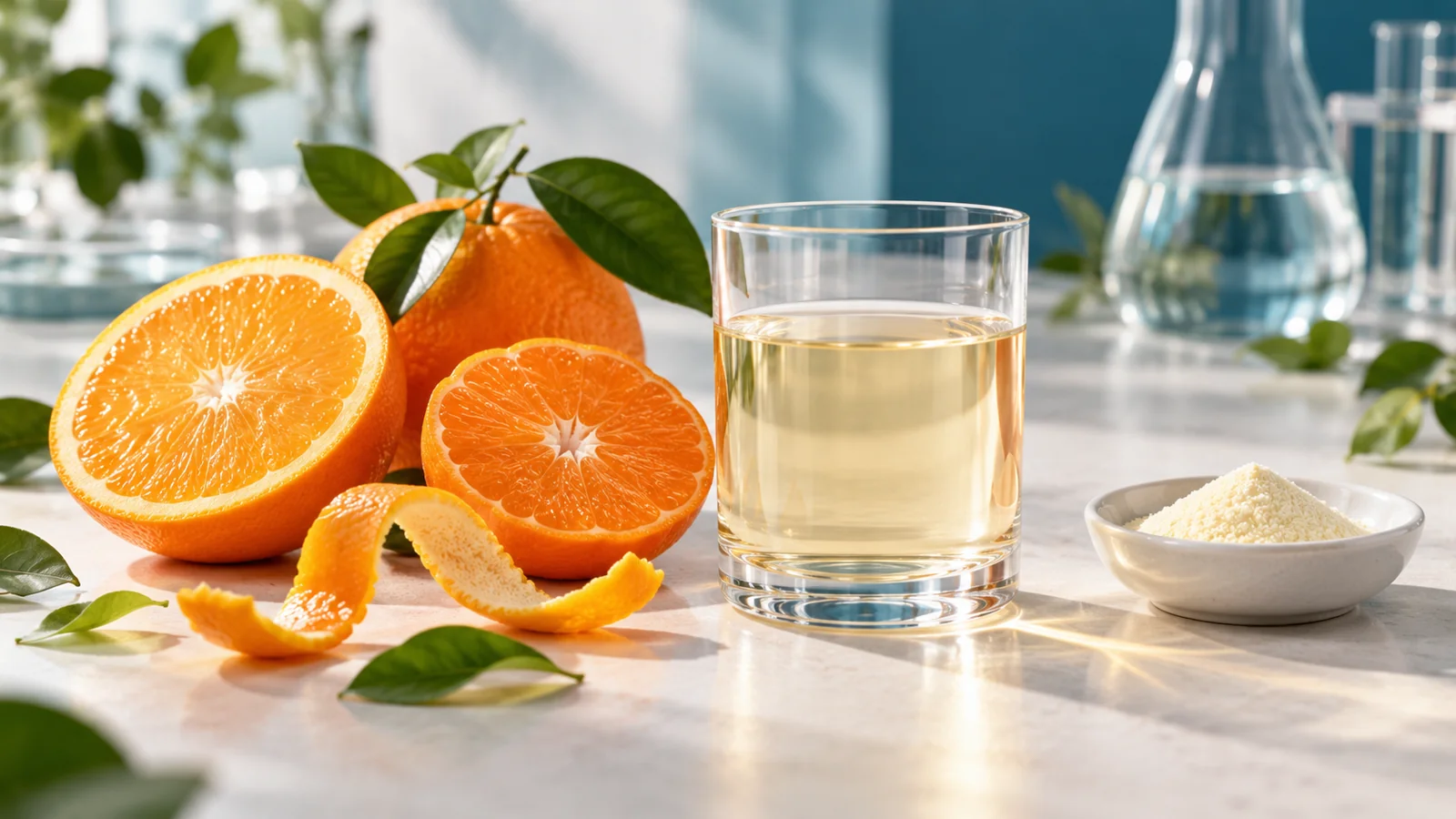
What would make a citrus flavonoid useful in the next beverage project? Ingredient selection starts with two questions: how it behaves in the water phase, and which research themes are relevant to the intended product.
Alpha-glucosyl hesperidin (α-Glucosyl Hesperidin, CAS 161713-86-6) is a glycosylated derivative of hesperidin. Glycosylation improves water solubility, opening a development route for ready-to-drink beverages and reconstituted powders. Small human studies of peripheral blood flow and temperature recovery also provide a research theme for seasonal nutrition concepts.
PathGene supplies alpha-glucosyl hesperidin raw material. This guide connects that ingredient choice with pilot formulation work, published research and lot-specific documentation.
AI-generated application concept, not a measured dissolution image of PathGene material.
What is alpha-glucosyl hesperidin, and how does it differ from hesperidin?
Hesperidin is a citrus flavonoid glycoside. Additional glucosyl groups modify its interaction with water. A commercial glycosylated material should also be characterized for monoglucosyl, other glycosylated fractions and residual hesperidin as applicable; similar product names do not establish identical composition.
| Purchasing question | Hesperidin | Alpha-glucosyl hesperidin |
|---|---|---|
| What is the ingredient? | A citrus flavonoid glycoside | A further-glycosylated hesperidin derivative |
| What matters in a water phase? | Low solubility can limit direct incorporation | Improved solubility supports screening at the intended concentration |
| Which documents should be compared? | Its own specification and test report | Composition, the measured fraction and lot COA |
| Which formats can be evaluated? | Appropriate dispersion or delivery systems | Ready-to-drink, powder sachet and warm-drink projects |
Kometani and colleagues reported approximately 300-fold higher water solubility for their isolated hesperidin mono- and diglucoside samples compared with hesperidin in 1994. That result supports the glycosylation approach; it is not a measured solubility multiplier for PathGene material. Original study
Build a dissolution record for the project: lot, concentration, water temperature, mixing time, pH and appearance after mixing and holding. Evaluate clarity, colour, assay retention and taste individually before selecting a finished formula.
What does the peripheral-temperature research contribute?
| Study | Design and research direction | Development relevance |
|---|---|---|
| Morishita et al., 2020 | Placebo-controlled crossover; 24 enrolled, 18 analysed; a 100 mL orange-flavoured beverage containing 100 mg of study material showed higher post-cold-challenge blood flow and temperature at selected times | A beverage can serve as a research vehicle |
| Yoshitani et al., 2008 | Crossover study in 11 cold-sensitive women, assessing single intake and seven-day intake | A small-sample research lead for a women-focused concept |
| Takumi et al., 2010 | Peripheral-temperature experiments under cool-room and warm-beverage conditions, with autonomic measurements | A research theme for office and warm-drink formats |
The 2020 study was conducted by Hayashibara researchers using company employees, with exclusions from the analysis. Those factors belong in the interpretation. Its intake amount is an experimental condition, not a finished-product recommendation.
The 2015 correction to the 2008 paper specifies that 250 mg of the enzyme-treated test material contained 178 mg monoglucosyl hesperidin. The 2010 paper also has a 2026 correction record; consult the journal correction when interpreting the study.
These studies help define research questions. They do not establish equivalent effects for PathGene lots or a customer's finished beverage. Match the study composition and conditions to the project, then develop evidence for the actual formula.
Three beverage concepts worth pilot evaluation
Seasonal citrus ready-to-drink nutrition
Orange or grapefruit flavour can connect a familiar drinking experience with a citrus-flavonoid theme. At the intended loading, compare colour, bitterness and the full flavour profile. Screen compatibility with acidulants, juice, sweeteners and other botanical ingredients.
Record addition order, heating and holding conditions, filling and container selection. Monitor assay, sediment, colour and sensory changes throughout processing and storage.
Portable powder drink mixes for office use
Sachets suit an office desk or travel bag. In the dry blend, check uniformity, flow, moisture and caking. Test reconstitution across the intended water temperatures, mixing instructions and holding times.
An easy-mixing claim should reflect the complete sachet formula. The solubility of one ingredient does not establish the behaviour of a blend containing acids, sweeteners or other flavonoids.
Women-focused warm-drink nutrition
The small cold-sensitivity study provides a literature lead for this audience. Citrus and tea flavours can be screened at the intended drinking temperature. Include a matched beverage control to distinguish the warm liquid's immediate experience from the ingredient research theme.
Evaluate repeat-use acceptability as well as ingredient retention. Product positioning, consumer experience and permissible label statements require their own evidence and destination-market review.
A practical pilot-development sequence
| Stage | What to record and test | Decision supported |
|---|---|---|
| Material qualification | CAS, lot, glycosylated composition, assay target and reporting basis | Is the purchased material the material being tested? |
| Ingredient in water | Intended concentration, temperature, pH and mixing time | Does dissolution meet project requirements? |
| Complete formulation | Add acids, sweeteners, juice and other actives stepwise; retain a blank control | Which components change appearance, taste or assay? |
| Process simulation | Reproduce heating, holding, cooling and filling | What changes during processing? |
| Packaged storage | Track assay, sediment, colour, taste and microbiological quality in the selected container | Can the formula and pack support the proposed storage conditions? |
This is a pilot framework. Concentrations, ratios and a stable pH or processing window must come from the project rather than an assumed universal formula.
PathGene batch COA: what should buyers review?
For example, the COA for PathGene lot PGGH-260511 records the following:
| Item | Lot specification | Lot result |
|---|---|---|
| Alpha-glucosyl hesperidin | ≥75.0%, dry basis | 80.1% |
| Moisture | ≤6.0% | 3.1% |
| Total ash | ≤2.0% | 0.4% |
| Colour | Pale yellow to brownish yellow | Complies |
| Packaging | 25 kg/drum | Reported lot pack size |
Production date: 11 May 2026. Test date: 20 May 2026. Storage: sealed, cool, dry and protected from light. These values describe that lot; obtain documents for the material offered for shipment.
The product page also displays a different batch. Before comparing percentages, clarify whether a report measures alpha-glucosyl hesperidin, monoglucosyl hesperidin or another defined fraction, and whether it uses a dry basis. Different item names and methods may represent different specification scopes.
Request composition information, a lot COA and an evaluation sample, then assess the material in the intended formulation. See the PathGene product page for ingredient information, and browse the product catalogue for other glycosylated flavonoids.
References
- Kometani T, et al. Transglycosylation to Hesperidin by Cyclodextrin Glucanotransferase from an Alkalophilic Bacillus Species in Alkaline pH and Properties of Hesperidin Glycosides Biosci Biotechnol Biochem. 1994;58(11):1990–1994. DOI 10.1271/bbb.58.1990.
- Morishita N, et al. Effects of Glucosyl Hesperidin on Skin Blood Flow and Temperature. 2020;57:129–134. Original paper.
- Yoshitani K, et al. Effect of α-Glucosylhesperidin on Poor Circulation in Women. 2008;61(5):233–239. Paper; 2015 correction.
- Takumi H, et al. Effects of α-Glucosylhesperidin on the Peripheral Body Temperature and Autonomic Nervous System. 2010;74(4):707–715. PMID 20378967; 2026 correction, PMID 41766616, DOI 10.1093/bbb/zbag019.
- PathGene COA: Alpha-Glucosyl Hesperidin, PGGH-260511, tested 20 May 2026. Company lot document, interpreted separately from published study materials.
For ingredient sourcing and formulation development. Confirm ingredient authorization, intended use and permitted claims in the destination market.
Frequently Asked Questions
Is glucosyl hesperidin the same as hesperidin?+
They are related but different supply forms. Alpha-glucosyl hesperidin is a further-glycosylated derivative. Check CAS, composition, assay target and the corresponding lot COA.
How should glucosyl hesperidin solubility be evaluated in beverages?+
Record the lot and test dissolution time, clarity and changes after holding at the intended concentration, pH and water temperature. Repeat in the complete formula. The published multiplier provides technical background; project specifications come from tests on the supplied material.
Can it be evaluated in both beverages and powder sachets?+
Both are development candidates. Ready-to-drink projects need processing and packaged-storage evaluation. Sachets additionally require dry-blend uniformity, moisture, caking and reconstitution tests.
Which development themes are supported by the human research?+
Small studies have examined fingertip blood flow and temperature recovery after cold exposure, and peripheral temperature under cool-room or warm-drink conditions. They can inform seasonal, office-use and women-focused nutrition research. Evaluate the finished product using its own material, formula, population and test conditions.
How should buyers compare an 80.1% assay result?+
Identify the measured fraction and reporting basis first. The 80.1% value is the dry-basis result for PGGH-260511; it is not automatically an as-received powder fraction or a result for later lots.
How can a formulation team start a glucosyl hesperidin project?+
Obtain ingredient documentation and evaluation samples, then run dissolution, flavour, processing and storage trials for the selected format. Contact PathGene for material information and sample arrangements.
Ready to evaluate our products?
Request a sample or send an inquiry — our R&D team responds within 24 hours.