
By PathGene Biotech · Technically reviewed by Alex Huang
Ergothioneine in Beverages: Solubility, Heat Processing and Storage Stability
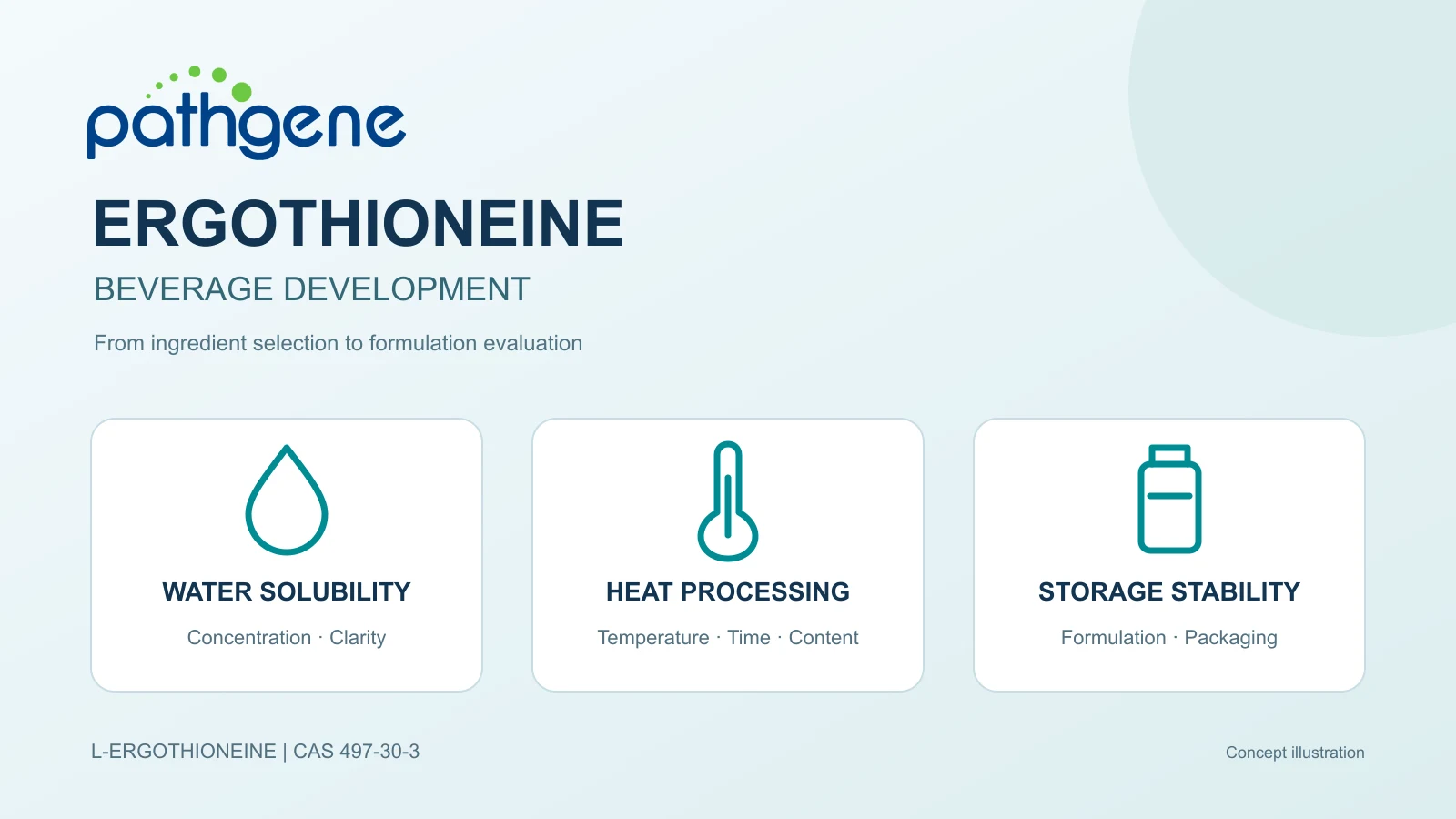
Ergothioneine (EGT) is soluble in water, making it a candidate for aqueous beverage formulations. The useful development question is whether it dissolves and remains clear at the intended concentration, pH and process conditions—not whether the ingredient is water-soluble in isolation. This guide separates dissolution, heat-processing and storage evidence from PathGene raw-material specifications.
Ergothioneine water solubility: how to start a beverage pilot
Water solubility is a useful starting point for aqueous EGT formulations. The 2025 paper describes EGT as highly water-soluble at room temperature, but its experimental focus was mixed-solvent behavior relevant to crystallization rather than complete beverages.[1]
A pilot study can begin with an aqueous EGT premix at the planned concentration. Record water temperature, mixing procedure, mixing time and final volume. Check for undissolved particles, haze or color changes, and distinguish the premix concentration from the finished-beverage concentration.
Next, incorporate the premix into the complete formulation and compare clarity, sediment and color before and after addition. This establishes whether the intended incorporation procedure works in the actual system.
For a clear beverage, include an otherwise identical formulation without EGT. The control helps distinguish changes associated with EGT addition from the appearance of the beverage base itself.
Record the preparation concentration: powder weighed (mg) ÷ final solution volume (mL) gives the nominal powder concentration in mg/mL. If reporting active EGT rather than powder mass, apply the agreed batch assay basis separately. This calculation describes the prepared sample; observing a clear sample at one concentration does not establish the solubility limit.
What does the published evidence actually measure?
Solubility, antioxidant activity and ingredient content are different endpoints. To use a study in a formulation decision, examine its test material, conditions and measurement method together.
| Development question | Published evidence | Relevance to a beverage project |
|---|---|---|
| Can EGT enter the aqueous phase? | A 2025 paper describes room-temperature water solubility and investigates four water–organic solvent systems.[1] | Supports aqueous incorporation research; does not establish a universal solubility limit for beverages |
| Does activity persist under heating? | A 2012 study reported high ORAC antioxidant activity at 25, 40, 60, 80 and 100°C.[2] | Supports process evaluation; activity results do not replace post-process EGT content measurements |
| Is there storage evidence? | A 2026 ocular-application study used HPLC in a six-month stability evaluation at 40°C/75% relative humidity; its abstract reports over 97% retention.[4] | Informs study design; it was not a finished-beverage or PathGene supply-batch experiment |
Heat processing: record temperature, exposure time and EGT content
Published heat studies support evaluation, but maintaining antioxidant activity at a test temperature is not the same as retaining unchanged ingredient content after a commercial process.[2]
Document a reproducible process rather than only its maximum temperature. Include heating, holding and cooling, and compare EGT content before and after processing. Hot-fill, pasteurization and other thermal routes should each be assessed using the project's intended temperature–time profile.
If antioxidant activity is also an endpoint, report it separately from EGT content. Confirm that the content method works in the beverage matrix, including blank interference, spike recovery and repeatability where needed.
The ingredient-selection decision should reflect performance under the actual process, rather than the highest temperature listed in a paper.
pH and co-ingredients: evaluate the complete formulation
A beverage may contain acidulants, vitamins, minerals, flavors and other active ingredients. Evaluate EGT at the planned formulation pH and with the relevant co-ingredients, alongside a simple aqueous system.
A 2020 study reported thermal, light and acid–base stability under its investigated conditions and observed reduced EGT concentration in the presence of copper ions.[3] Copper-containing formulations therefore warrant specific evaluation; this finding does not establish incompatibility with every mineral.
Useful comparisons include:
- the beverage base with and without EGT;
- EGT alone and EGT combined with key co-ingredients;
- content and appearance within the intended pH range, after processing and during storage.
For combinations such as EGT and vitamin C, formulation compatibility and efficacy synergy are separate questions. Evidence for individual ingredients does not by itself demonstrate synergy in a finished combination.
Storage stability: generate evidence in the intended formulation and packaging
The six-month accelerated study provides a useful research reference. Its results cannot directly establish commercial beverage shelf life because the beverage formulation, packaging and storage conditions differ from the research system.[4]
Record at least:
- EGT content: compare sampling points against a defined initial sample using a consistent analytical basis;
- appearance: color, clarity, haze and sediment;
- formulation properties: pH and other project-specific quality attributes;
- packaging conditions: container, closure, fill volume, light exposure and storage environment.
Microbiological, sensory and other finished-product endpoints remain part of the product quality plan. Ingredient-content stability answers only part of the shelf-life question.
A practical framework for an EGT beverage pilot
The following is a development-record framework. Test levels and sampling times should follow the project's process and quality objectives.
| Stage | Suggested comparison | Main records |
|---|---|---|
| Premix | Intended concentration and mixing procedure | Ingredient amount, volume, water temperature, mixing time, dissolution and appearance |
| Complete formulation | Beverage base with and without EGT | pH, clarity, color, sediment and EGT content |
| Key combinations | EGT alone versus relevant mineral or active-ingredient combinations | Ingredient ratios, content and appearance changes |
| Heat processing | Unprocessed sample versus the intended temperature–time profile | Full process record and pre-/post-process EGT content |
| Packaged storage | Intended packaging and storage conditions | Sampling times, content, pH, appearance and finished-product quality endpoints |
Retain the ingredient lot number and matching COA so that material identity and analytical specifications remain traceable across pilot runs.
PathGene L-ergothioneine powder: supply specifications and documents
PathGene supplies L-ergothioneine powder, CAS 497-30-3, with a published purity specification of ≥99.5% and water solubility listed as soluble in water. Batch COAs and evaluation samples are available.[5]
| Ingredient information | Published PathGene specification |
|---|---|
| Product | L-Ergothioneine Powder |
| CAS | 497-30-3 |
| Purity | ≥99.5% |
| Water solubility | Soluble in water |
| MOQ | 100 g |
| Pack sizes | 100 g / 500 g / 1 kg |
| Ingredient storage | Tightly closed, dry, at room temperature and protected from light |
| Ingredient shelf life | 24 months under the specified storage conditions |
Use the batch COA to review identity, the analytical basis for purity and assay, impurities, loss on drying and other project-specific quality requirements. If a specific water-content test is required, check its method rather than treating loss on drying as an equivalent measurement. Read release specifications separately from the measured results for a particular lot.
These are ingredient supply details. The published stability studies cited here are not test reports for PathGene material or a finished beverage.
View PathGene L-ergothioneine powder specifications and quality documents · Request batch documents and evaluation samples
Food use and commercialization should be checked against the ingredient scope, conditions of use and finished-product requirements of the target market.
Request an EGT sample for a beverage pilot
To discuss a sample or bulk quotation, share the target EGT concentration, beverage pH, key co-ingredients, proposed heat process and required quantity. These details help define what to evaluate; they do not establish finished-product suitability before testing.
- Match the sample lot to its COA and distinguish the release specification from that lot's results.
- Use the same preparation and analytical basis when comparing samples or suppliers.
- Keep a record of dissolution, post-process content and packaged storage results for the actual formulation.
Request an EGT sample or bulk quotation · Review EGT batch quality documents
References
- Li T, et al. Thermodynamic data and properties of Ergothioneine in binary solvent systems and its microscopic mechanisms. Journal of Molecular Liquids. 2025;437:128519. Publisher page · DOI. Scope cited: water solubility and mixed-solvent research, not finished-beverage solubility.
- Fukuda E, et al. The effects of heat and pH on the antioxidative activity of ergothioneine from Pleurotus cornucopiae. Bulletin of Fuji Women's University, Series II. 2012;49:51–55. Academic abstract record. Scope cited: antioxidant activity under the investigated conditions.
- Liu X, et al. A Study on the Antioxidant Properties and Stability of Ergothioneine from Culinary-Medicinal Mushrooms. International Journal of Medicinal Mushrooms. 2020;22(3):211–220. PubMed. Scope cited: reported stability and copper-ion effects, without extrapolation to all beverage combinations.
- He R, et al. Ergothioneine: Evaluation of a Novel Antioxidant for Targeting Ocular Oxidative Stress. Current Eye Research. 2026;51(5):608–614. Publisher article. Scope cited: accelerated stability reported in the abstract, not ocular findings as evidence of beverage efficacy or safety.
- PathGene: L-ergothioneine powder product page. Public information checked on October 9, 2026.
Frequently Asked Questions
Is ergothioneine water-soluble, and is there one concentration limit for all beverages?+
Ergothioneine is water-soluble, but a universal numerical limit is not established here for every beverage. Test the actual ingredient at the intended concentration, temperature and pH in water and in the complete formula, recording dissolution, clarity and any sediment.
Can ergothioneine be evaluated in clear beverages?+
Its water solubility provides a basis for aqueous incorporation. Compare the complete formulation with an EGT-free control at the intended concentration, checking haze, sediment and color after processing and during storage.
How can I start evaluating EGT incorporation?+
Prepare an aqueous premix at the intended concentration and then incorporate it into the beverage base. Record concentration, water temperature, mixing procedure and time. Keep premix and finished-product concentrations distinct; select the final procedure from pilot results.
Can EGT be considered for hot-fill or pasteurized beverages?+
It can be included in ingredient screening for these processes. Use EGT content measured after the actual temperature–time profile as the decision basis; published activity studies do not guarantee retention under every beverage process.
Does retained antioxidant activity mean unchanged EGT content?+
Not necessarily. Activity and content are different endpoints, and analytical methods or other formulation ingredients affect interpretation. Report each measured endpoint separately.
Can EGT be combined with minerals or vitamin C?+
Evaluate the actual ingredients and ratios. Copper is one variable identified in published research. Compare the ingredient alone, the combination and the formulation blank for content and appearance; individual-ingredient evidence does not establish combination stability or efficacy synergy.
Does the ingredient's 24-month shelf life apply to an EGT beverage?+
No. That period applies to the ingredient under its stated storage conditions. Beverage shelf life requires evidence for the complete formulation, packaging and finished-product quality attributes.
Which documents should accompany an evaluation sample?+
Obtain the COA matching the sample lot, ingredient specifications, analytical basis, storage instructions and packaging information. Link these to the project's pilot records. Literature results or another lot's data cannot replace the supplied lot's measured results.
Ready to evaluate our products?
Request a sample or send an inquiry — our R&D team responds within 24 hours.