
By PathGene Biotech · Technically reviewed by Alex Huang
Phosphatidylserine 50% vs 70%: Supplier and COA Guide
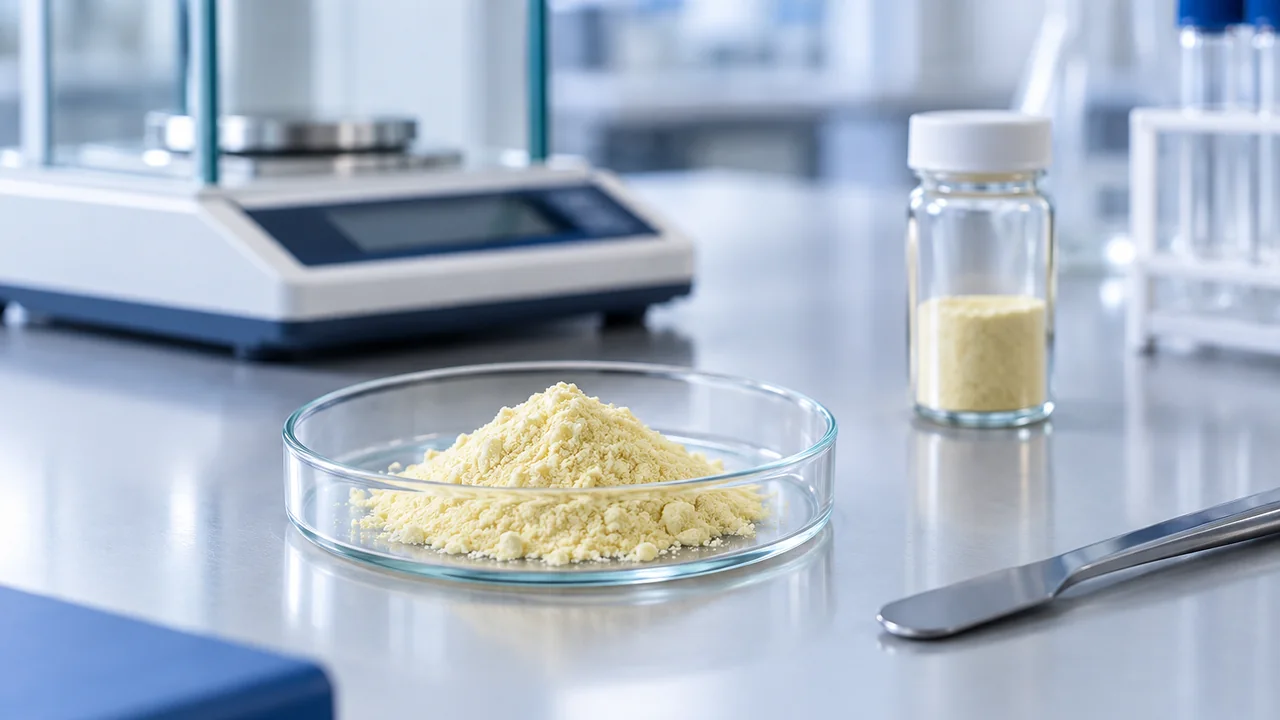
When comparing phosphatidylserine powder suppliers, specify whether you need PS 50% or PS 70%, then review the offered lot, composition and assay basis. PathGene's 50% batch PGPS50-20260325 reports 53.9 g/100 g PS; its 70% batch PGPS70-20260601 reports 71.2% PS. These are two separate batch results, not interchangeable certificates or guarantees for every future lot.
The published product-page batch summary currently covers the 70% lot. Below, compare both grades using their matching COAs, confirm source and carrier information separately, and normalize quotations only after agreeing the assay basis.
PathGene 70% phosphatidylserine: published lot data
PathGene's product page identifies lot PGPS70-20260601, tested on June 2, 2026, against QB/T 5821-2023. The page lists the following specification limits and results:
| Test | Specification | Published lot result |
|---|---|---|
| Phosphatidylserine content | ≥70% | 71.2% |
| Peroxide value | ≤10 meq/kg | 3.77 meq/kg |
| Moisture | ≤2.0% | 0.81% |
| Particle size | 98% passes 40 mesh | Complies |
| Acetone-insoluble matter | ≥95 g/100 g | ≥95.27 g/100 g |
| Total plate count | ≤1,000 CFU/g | 150 CFU/g |
The PS result clears the 70% minimum by 1.2 percentage points. Peroxide value is about 38% of its stated maximum; moisture is about 41% of its maximum; total plate count is 15% of its limit. These are reported measurements, not “not detected” claims. All listed results on the page are marked compliant.
This table refers to the product page's current lot summary. It is not a substitute for the complete signed COA, and it does not imply that every future lot will have identical results. Ask PathGene for the COA matching the grade and batch being purchased.
PS 50% versus 70%: compare the matching batch evidence
| Check | 50% grade example | 70% grade example |
|---|---|---|
| Batch | PGPS50-20260325 | PGPS70-20260601 |
| PS specification and result | ≥50 g/100 g; result 53.9 g/100 g | ≥70%; result 71.2% |
| Moisture | 0.95 g/100 g | 0.81% |
| Acetone-insoluble matter | 98.5 g/100 g | ≥95.27 g/100 g |
| Stated specification reference | QB/T 5821-2023 | QB/T 5821-2023 |
| Storage statement | Sealed, cool and dry; avoid moisture and direct sunlight. | |
The percentages describe the PS fraction under the reported method. Acetone-insoluble matter is a separate test and should not replace the PS assay. The reviewed certificates do not establish that the remaining fraction is a particular carrier or a specific phospholipid mixture. Request the grade's composition statement rather than calling 50% PS “half filler.”
The peroxide entries on these two COAs use different units; do not rank oxidation quality by comparing their numbers directly. Request the method, reporting unit and calculation basis. The references and shelf-life statements shown on a COA apply to the supplied raw material and do not establish finished-product stability.
Compare bulk quotations by documented PS content
For an illustrative raw-material calculation on the same agreed basis, delivering a theoretical 1 kg of PS would require 2 kg of 50% material or approximately 1.429 kg of 70% material. This is a procurement mass calculation, not an intake recommendation. For a real order, use the agreed specification or verified lot result as required by your contract.
If the powder prices per kilogram are P50 and P70, the corresponding theoretical costs per kilogram of PS are P50 / 0.50 and P70 / 0.70. Under those assumptions, equal PS-material cost occurs at P70 = 1.4 × P50. Source, carrier, assay basis, process loss, packaging, testing, freight and formulation performance still need separate comparison; a higher concentration alone does not determine the best purchase.
Source, carrier and allergen information are grade-specific
Ask the supplier for the source material, any added carrier, other declared components and an allergen statement for the quoted grade. Neither reviewed batch certificate identifies soy or sunflower origin or proves that the material is carrier-free, soy-free or allergen-free. The phosphatidylserine product record treats the material as a mixture and does not assign a single CAS number. A chemical database entry for one molecular species does not define the entire commercial ingredient.
Choose the grade against your blend-uniformity, fill-volume, dispersion and processing requirements using a matched sample. A higher PS assay can reduce theoretical ingredient mass, but does not by itself establish better flow, dispersion, shelf life or clinical performance.
What should a phosphatidylserine assay method demonstrate?
The available 50% specification names HPLC for PS content, while the two batch certificates do not set out a complete detector, extraction, calibration or calculation procedure. Ask for the grade-specific method, reference-standard assignment, extraction recovery, separation from other lipid classes, detector response, precision and reporting basis. Do not label a research method as PathGene's routine method without matching documentation.
Avalli and Contarini (2005) evaluated lipid extraction and phospholipid separation in dairy systems, including PS measurement by SPE/HPLC/ELSD. This illustrates the need to review sample preparation and calibration; it does not validate an assay for these PS powders or establish the detector used for either lot.
For procurement, pair the PS assay with the lot's moisture, peroxide value, residual-solvent information and relevant microbiology. Confirm the unit and basis of each result. A passed release COA is not a substitute for compatibility and stability work in the final formulation.
For supporting documents, review the quality and documentation page.
Product and sourcing information
| Item | Product-page information |
|---|---|
| Product | Phosphatidylserine (PS) powder |
| Grades | 50% and 70% |
| CAS | Mixture; no single CAS number is assigned on the product page |
| Appearance | Pale-yellow powder or granules |
| Dispersion | Can be dispersed in suitable lipid or emulsion systems; validate in the target formula |
| Storage | Sealed, cool, dry, and protected from light |
| Stated shelf life | 24 months |
PS is a phospholipid ingredient supplied by concentration grade; it should not be treated as a single, fully pure small molecule. Source, carrier, and assay basis matter in addition to the headline percentage. PathGene's product page identifies it as a manufacturer and supports bulk sourcing. Buyers can share the intended grade, application, target market, and purchase quantity to confirm the corresponding specification, COA, sample, packaging, and lead time.
See the PathGene phosphatidylserine 50% / 70% product page for current product information and batch documentation requests.
What does the research say about phosphatidylserine?
PS is an anionic phospholipid found in cellular membranes. Research reviews describe its membrane distribution and roles in cell signaling; that biological context is distinct from proof that a particular commercial ingredient produces a clinical outcome.
A 2022 systematic review and meta-analysis selected nine studies in older adults—five randomized controlled trials and four pre-post studies—with 961 participants in total. The review reported a positive memory signal among older adults with cognitive decline. It also combined studies that differed in design, population, duration, and PS source, so the result should be read in that context. Read the 2022 review.
Individual trials have not been uniform. A 2001 randomized study assigned 120 older adults with memory complaints to placebo or 300/600 mg per day of soy-derived PS; it found no significant differences between treatment groups in the measured cognitive outcomes. A 2010 trial of 78 older adults reported that some memory changes were concentrated in participants with lower baseline scores, while test scores also increased in the placebo group. These studies used particular soy-derived materials and study conditions; they do not establish clinical efficacy for every PS source, grade, or finished product. 2001 trial · 2010 trial.
For ingredient buyers, the practical takeaway is to keep two reviews separate: assess the ingredient using its identity, grade, lot-specific COA, and formulation performance; assess any health or product claim against evidence for the exact source, dose, population, and finished formula.
PS supplier checklist for procurement teams
Before approving a bulk PS ingredient, confirm:
- Grade and identity: 50% or 70%, product name, source, carrier, and the identity/CAS convention used in the specification.
- Assay and method: PS content, analytical method, calculation basis, and whether results are reported as-is or on another basis.
- Lot-matched evidence: Batch number, test date, specification, actual result, and a COA for the material to be shipped.
- Supporting quality tests: Peroxide value, moisture, particle size, acetone-insoluble matter, and relevant microbiological limits and results.
- Application fit: Dispersion, process conditions, packaging, storage, shelf life, and any market-specific documentation needed for the finished product.
The currently published PathGene 70% lot provides a clear starting point for review: 71.2% PS, 3.77 meq/kg peroxide value, 0.81% moisture, and 150 CFU/g total plate count. Contact PathGene through the PS product page to request grade-specific specifications and the COA for the lot under consideration.
References
- Calianese DC, Birge RB. Biology of phosphatidylserine (PS): basic physiology and implications in immunology, infectious disease, and cancer. Cell Communication and Signaling. 2020;18:41.
- Kang EY, et al. Effect of phosphatidylserine on cognitive function in the elderly: A systematic review and meta-analysis. Korean Journal of Food Science and Technology. 2022;54(1):52–58.
- Jorissen BL, et al. The influence of soy-derived phosphatidylserine on cognition in age-associated memory impairment. Nutritional Neuroscience. 2001;4(2):121–134.
- Kato-Kataoka A, et al. Soybean-derived phosphatidylserine improves memory function of the elderly Japanese subjects with memory complaints. Journal of Clinical Biochemistry and Nutrition. 2010;47(3):246–255.
Frequently Asked Questions
What phosphatidylserine grades does PathGene offer?+
The product page lists 50% and 70% powder grades. Confirm the target grade and review its own specification and lot-matched COA.
What does the 71.2% result mean?+
It is the reported PS content for product-page lot PGPS70-20260601, tested on June 2, 2026. It is 1.2 percentage points above that lot’s 70% minimum; other lots should be assessed from their own COAs.
Does phosphatidylserine have one CAS number?+
The PathGene product page identifies this grade-based phospholipid ingredient as a mixture and does not assign one single CAS number. Confirm the exact material identity and documentation needed for your specification.
Is the PS soy-free or sunflower-derived?+
Do not infer source or allergen status from the name PS powder. Request source, carrier, and allergen information for the specific grade being quoted.
How do I request a specification or COA?+
Use the PathGene phosphatidylserine product page to contact the team with your target grade, quantity, and destination market. Request the documents matching the batch being evaluated.
Can the non-PS fraction be assumed to be a carrier?+
No. The grade percentage does not identify the remaining components. Request a composition statement and any carrier declaration for the exact grade; the reviewed COAs do not establish carrier-free status.
How do I compare the cost of 50% and 70% PS powder?+
On the same confirmed assay basis, divide powder price by the PS fraction. For nominal 50% and 70% grades, use P50/0.50 and P70/0.70, then assess source, carrier, processing, testing and delivery costs separately.
What does the 50% lot actually report?+
COA PGPS50-20260325 reports PS 53.9 g/100 g against ≥50 g/100 g and moisture 0.95 g/100 g. These results apply to that lot; request the COA for the material being offered.
Ready to evaluate our products?
Request a sample or send an inquiry — our R&D team responds within 24 hours.