
By PathGene Biotech · Technically reviewed by Alex Huang
Fermentation-Based PQQ Disodium Salt Powder: Formulation and COA Review Guide
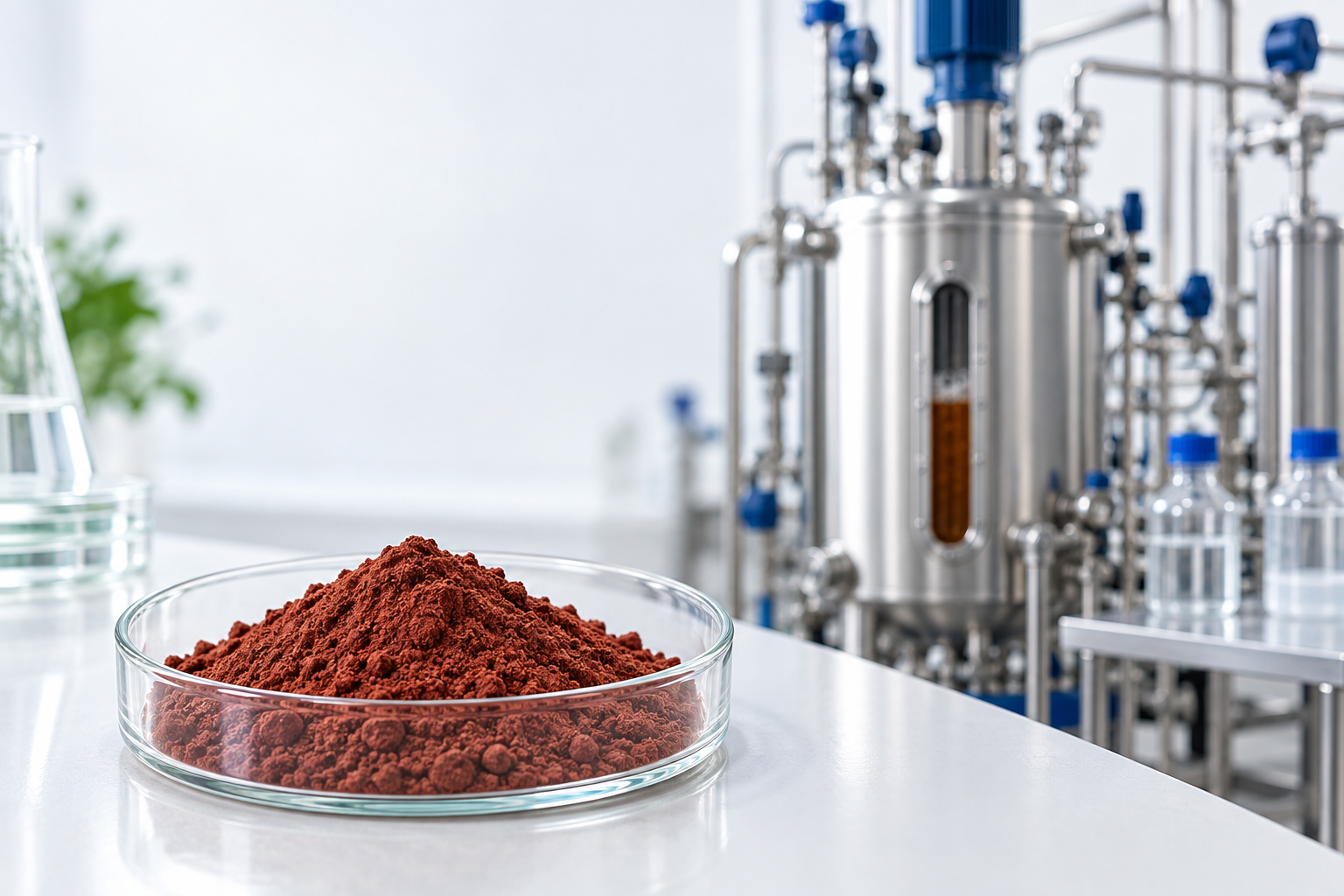
Pyrroloquinoline quinone disodium salt, commonly called PQQ disodium salt, is supplied as a powder ingredient for nutritional, formulation and biochemical research projects. Commercial PQQ may be produced through a controlled microbial fermentation route followed by separation, purification and disodium-salt conversion, or through a chemical synthesis route. For buyers, the key question is not simply whether a supplier lists “PQQ powder.” The material should be checked by process route, salt form, CAS number, assay basis, appearance, stability controls and batch documentation.
This guide explains why fermentation-based PQQ is often preferred for a documented ingredient supply chain, how it compares with chemically synthesized PQQ, and which checks help a formulator compare bulk PQQ powder suppliers before sampling or placing an order.
1. Confirm the identity of PQQ disodium salt
PQQ disodium salt should be distinguished from PQQ free acid and from unrelated quinone ingredients. The first purchasing check should include:
- Product name: Pyrroloquinoline Quinone Disodium Salt
- CAS number: 122628-50-6
- Molecular formula: C₁₄H₄N₂O₈·2Na
- Molecular weight: 374.17 g/mol
- Physical form: red to dark-brown powder, subject to the supplier’s approved specification
The CAS number and salt form should match across the quotation, product specification, sample label, COA and shipping documents. A product name alone is not sufficient to confirm identity.
2. Fermentation-based PQQ versus chemical synthesis
The production route is a meaningful procurement question because it affects which process controls and impurity checks should be reviewed. It does not replace batch testing: a route description alone cannot prove the quality of a finished lot.
Fermentation-based route
In a fermentation-based process, a controlled microorganism is cultivated under defined conditions to produce the PQQ intermediate. The process then uses clarification, separation and purification steps before conversion to the disodium salt and drying into a powder. From a buyer’s perspective, the value of this route is a traceable biological production platform with defined fermentation parameters and a clear downstream purification sequence.
For a fermentation-based PQQ supplier, ask for confirmation of:
- The production route and the product’s salt form
- The key fermentation and downstream purification stages
- How process-related impurities are controlled and removed
- Identity, assay, related substances and moisture methods
- Batch traceability from production through final packing
Chemical synthesis route
Chemical synthesis can use a series of reactions, reagents and purification operations to build the target molecule. The route may be appropriate for some supply chains, but the buyer should pay particular attention to reaction intermediates, residual solvents, catalyst or reagent residues and the analytical methods used to demonstrate their control.
This is not a conclusion that every chemically synthesized lot is unsuitable. The correct comparison is between the documented process, the specification and the actual batch results. Suppliers should be able to explain the route and provide quality evidence appropriate to the intended application.
Practical comparison for procurement
| Review point | Fermentation-based PQQ | Chemically synthesized PQQ |
|---|---|---|
| Process identity | Microbial fermentation followed by separation, purification and salt conversion | Chemical reaction sequence followed by purification and salt conversion where applicable |
| Main process questions | Fermentation parameters, clarification, purification and bioburden control | Reagents, reaction intermediates, residual solvents, catalysts and by-products |
| Best supporting evidence | Route statement, process overview, identity/assay data and batch COA | Route statement, impurity/residual-solvent data and batch COA |
| Buyer preference | Often preferred when process traceability and a biological production platform are important | May be considered when the supplier can document route control and impurity clearance |
For buyers specifically seeking fermentation-based PQQ, the supplier should confirm the route for the quoted grade and batch rather than relying on a general company statement. PathGene’s PQQ supply is positioned around a controlled microbial fermentation platform, followed by purification and disodium-salt processing; buyers can request the current product specification and relevant batch documentation for project review.
3. Review assay and purity on the correct basis
PQQ specifications can be reported using different terms, including purity by HPLC, assay on a dry basis and loss on drying. These values should not be treated as interchangeable.
Before comparing two PQQ powder suppliers, ask:
- What analytical method is used for identification and assay?
- Is the result reported on an as-is or dry basis?
- Is the stated value a specification limit or a batch result?
- Are moisture, related substances, residual solvents, elemental impurities and microbial limits included where relevant?
A specification such as “not less than” is a release requirement. A batch COA shows the measured result for a particular lot. Buyers should review both documents and confirm that the sample, batch number and quoted grade are aligned.
4. Why powder handling and light protection matter
PQQ disodium salt is normally handled as a fine powder and may be used in capsules, premixes or research solutions. Powder quality is affected by moisture exposure, light, packaging integrity and the time between opening and use.
For a formulation screening project, record:
- Color and appearance after opening
- Powder flow and visible agglomeration
- Dispersion or dissolution behavior in the intended vehicle
- Container closure and desiccant requirements
- Storage conditions stated in the specification and COA
Color alone cannot prove identity or purity. A qualified supplier should provide an analytical method and batch documentation rather than relying on appearance as the only quality indicator.
5. Formulation checks before scale-up
PQQ powder should be evaluated in the actual dosage form instead of being selected only from a catalog page. Common screening points include:
Capsules and dry premixes
Check blend uniformity, powder flow, segregation risk and the compatibility of excipients. Small pilot batches can reveal whether the selected particle profile and packaging are suitable for the intended process.
Water-based systems
Confirm dissolution or dispersion at the target concentration, pH and temperature. If the formulation is sensitive to light, use an appropriate container and define the exposure limits during processing.
Research solutions
Use the supplier’s current specification and project-specific method to confirm preparation conditions. A solution-screening result should not automatically be converted into a finished-product efficacy claim.
The formulation team should document the test vehicle, concentration, pH, temperature, mixing time and observation window. These details make supplier comparisons more reproducible.
6. What to request from a bulk PQQ powder supplier
For a serious sourcing review, request a complete document set rather than a single purity number:
- Product specification or technical data sheet
- Recent batch COA with batch number and test date
- Identity and assay method summary
- Appearance, moisture and relevant impurity limits
- Heavy-metal or elemental-impurity information where applicable
- Microbial limits for the intended grade
- Packaging, storage and shelf-life information
- Sample quantity, MOQ, lead time and shipping conditions
- OEM or formulation-support scope, if required
When a recent batch COA is not already published, the buyer can ask the supplier to confirm the available product grade and provide the relevant batch document for review.
7. How to compare PQQ suppliers without creating a false price comparison
The lowest quoted price is not necessarily the lowest procurement cost. Compare suppliers using the same basis:
- Same salt form and CAS number
- Same assay basis and specification limit
- Same packaging and net weight
- Same Incoterm and destination
- Same documentation scope
- Same sample and replacement policy
If one quotation includes only a product name and another includes a current COA, specification, sample and packaging information, the two offers are not yet comparable. First normalize the technical and delivery conditions, then compare price.
8. Evidence and responsible product communication
PQQ is discussed in nutritional and biochemical research, but research evidence about a compound should not be presented as proof that every finished product produces a specific human outcome. Product pages and commercial materials should separate:
- Raw-material identity and quality data
- In-vitro, animal or human research findings
- Formulation performance
- Permitted finished-product claims in the target market
This separation protects both the buyer’s regulatory review and the supplier’s product information. For procurement, the most useful evidence is often the combination of a clear specification, a traceable batch COA and a sample evaluation under the buyer’s own process conditions.
FAQ: PQQ disodium salt powder
Is PQQ disodium salt the same as PQQ?
PQQ is a common short name, but commercial material may be supplied as a particular salt form. Confirm that the quoted material is PQQ disodium salt and that CAS 122628-50-6 appears consistently in the technical documents.
What CAS number is used for PQQ disodium salt?
The product reference used in this guide is CAS 122628-50-6. Buyers should still confirm the salt form and identity in the supplier’s current specification and COA.
What should a PQQ COA contain?
At minimum, review the product identity, batch number, test date, assay method, assay result, appearance and any grade-specific moisture, impurity, elemental or microbiological requirements.
Is fermentation-based PQQ better than chemically synthesized PQQ?
That depends on the buyer’s quality, documentation and supply-chain requirements. Fermentation-based PQQ is often preferred when the buyer values a controlled microbial platform and process traceability. The final decision should still be based on the route statement, specification, analytical methods and actual batch COA.
Does a darker color mean that PQQ powder is lower quality?
Not by itself. Color is one appearance attribute, not a substitute for identity testing and assay. Use the approved appearance specification together with the COA and analytical method.
Can PQQ powder be used directly in a finished product?
That depends on the target market, grade, formulation, process and applicable regulations. Complete a formulation and compliance review before making finished-product claims or commercializing a product.
Request PQQ documentation or a sample
PathGene supplies fermentation-based PQQ disodium salt powder under the product reference CAS 122628-50-6. Buyers can review the current product specification, request a sample and ask the sales team to confirm the production route, relevant batch COA, packaging and delivery conditions on the PQQ product page.
Frequently Asked Questions
Is PQQ disodium salt the same as PQQ?+
PQQ is a common short name, but the purchase specification should confirm the exact disodium salt form and CAS 122628-50-6.
Is fermentation-based PQQ better than chemically synthesized PQQ?+
Fermentation-based PQQ is often preferred when process traceability and a controlled microbial platform are important. The final decision should be based on route documentation, specifications, methods and the actual batch COA.
What should a PQQ COA contain?+
Review identity, batch number, test date, assay method and result, appearance, and applicable moisture, impurity, elemental and microbiological requirements.
Can PQQ powder be used directly in a finished product?+
That depends on the grade, formulation, process, target market and applicable regulations. Complete formulation, quality and compliance review before commercialization.
Ready to evaluate our products?
Request a sample or send an inquiry — our R&D team responds within 24 hours.