
By PathGene Biotech · Technically reviewed by Alex Huang
NMN Formulation Stability: Process, Packaging and Testing Plan
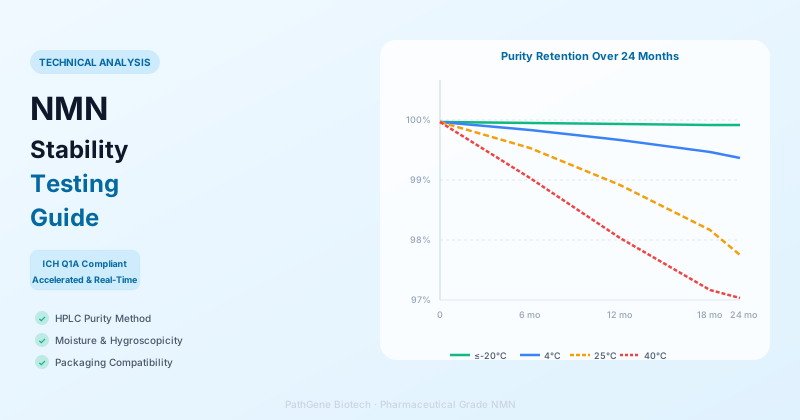
NMN stability testing should answer a defined question about the actual material or formulation. Begin with the beta-NMN identity, lot, intended dosage form, manufacturing process and proposed packaging rather than a universal shelf-life assumption.
What published NMN research establishes
A validated HPLC study investigated NMN under forced acid, base, oxidative, light and thermal conditions and reported significant degradation under basic and thermal conditions.[1] Those experiments support examining process exposure and analytical methods; they do not establish a shelf life for every commercial powder, capsule or beverage.
Define the material, process and packaging
- Identify the lot and agreed release specification using the NMN batch COA review.
- Record formulation ingredients, pH where applicable and the complete processing conditions.
- Document the intended container, closure, fill quantity and storage or transport conditions.
- Separate bulk-powder evaluation from the final packaged formulation.
A project-specific NMN testing plan
| Stage | Comparison | Records |
|---|---|---|
| Initial material | Approved sample and intended production lot | Identity, specification, method, initial content and lot |
| Manufacturing | Before and after the intended process | Exposure time, temperature and relevant formulation properties |
| Packaged storage | Defined conditions and sampling times | NMN content, relevant impurities, appearance and packaging |
| Finished-product review | Observed results against agreed acceptance criteria | Quality, microbiological and other product-specific endpoints |
Choose temperature, humidity, light exposure and sampling points for the actual project and target market. Accelerated or stress experiments and real-time storage answer different questions; do not treat a short stress result as a guaranteed expiry date.
Use an analytical method suitable for the formulation
Confirm that the method distinguishes the NMN signal from matrix interference and relevant degradation products. Consider specificity, recovery and repeatability as applicable. Purity, assay, water content and loss on drying are separate reported attributes; specify the required method and acceptance basis instead of applying unexplained numerical thresholds.
Dosage form and packaging change the question
Capsules, tablets, powder blends and liquid formulations differ in their processing and storage exposure. Evaluate the intended excipients and packaging together. Powder storage instructions do not directly establish a beverage or capsule shelf life, and one dosage form should not be assumed to be best for every project.
How ICH guidance should be used
ICH Q1A(R2) addresses stability testing for new drug substances and products.[2] It can inform study-design discussions where appropriate, but it is not a universal food-supplement rule or evidence of an NMN project's compliance. Determine the applicable requirements with the intended product category and market.
Discuss NMN samples and available documents
PathGene's listed beta-NMN powder specification is ≥99.5% purity. Review the matching lot documents and confirm what storage or stability information is available for the requested material. A listed ingredient expiry period, release COA and completed finished-product stability study are different kinds of information.
Request NMN samples and discuss project requirements · Compare NMN supplier and delivery terms
References
- Zhou H, et al. A Novel HPLC Method for Quality Inspection of NRK Biosynthesized β-Nicotinamide Mononucleotide. Journal of Chromatographic Science. 2024;62(3):241–248. PubMed abstract; DOI: 10.1093/chromsci/bmac107. Forced-degradation and method study, not a PathGene stability report.
- ICH Q1A(R2): Stability Testing of New Drug Substances and Products. Scope: drug substances and products.
Ready to evaluate our products?
Request a sample or send an inquiry — our R&D team responds within 24 hours.