
By PathGene Biotech · Technically reviewed by Alex Huang
PQQ and CoQ10: Evidence & Formulation Guide
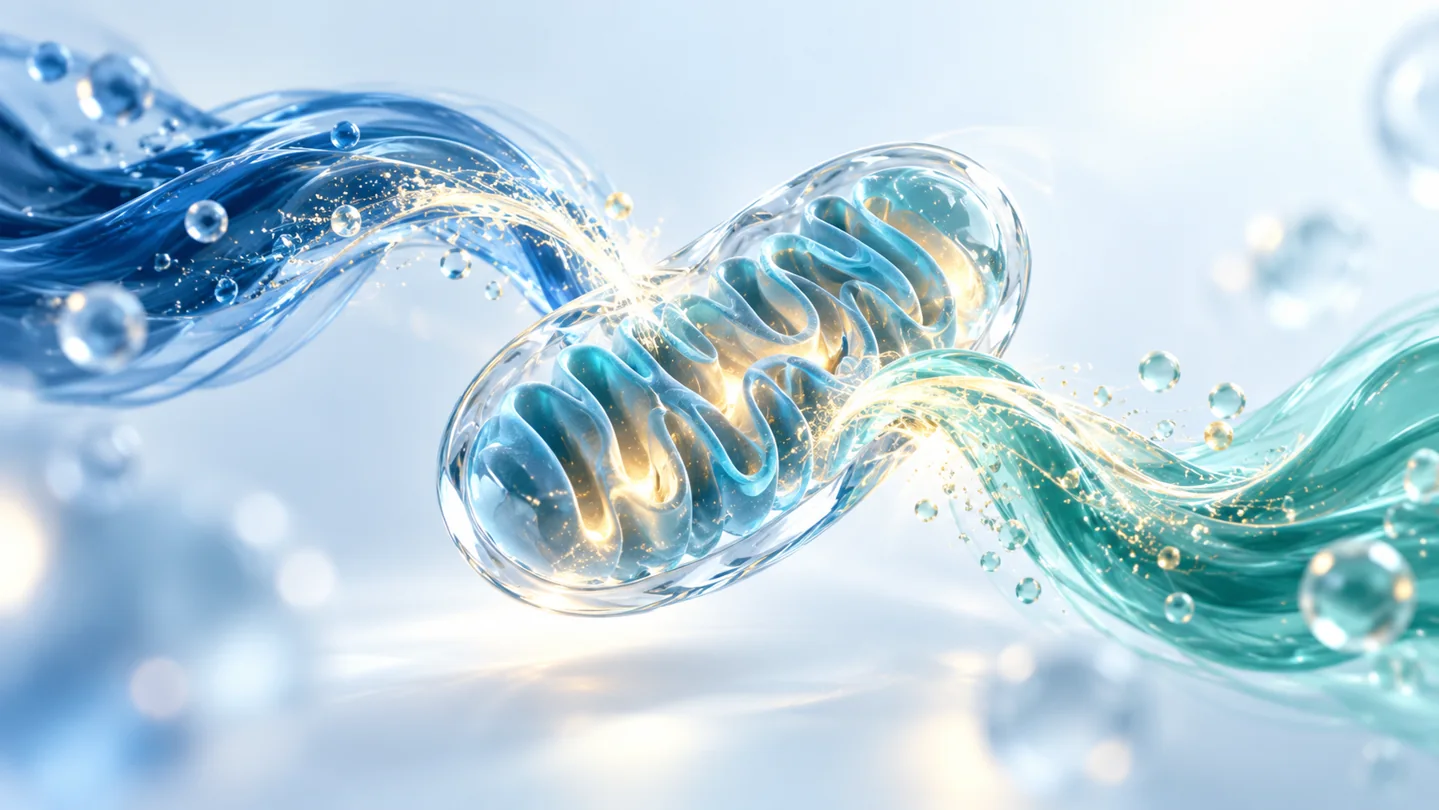
PQQ and CoQ10 are considered together because they offer different research angles on mitochondrial nutrition: CoQ10 participates in electron transfer, while PQQ has cell-model evidence involving mitochondrial-biogenesis signaling. This is a testable formulation rationale. Results from individual ingredients still need to be distinguished from results for the final combination.
The cover is an AI-generated mitochondrial-nutrition concept, not an experimental image or an exact pathway diagram. This guide is for ingredient buyers, brands and formulation teams.
What are PQQ and CoQ10?
PQQ stands for pyrroloquinoline quinone. A common form in oral-nutrition research and ingredient supply is PQQ disodium salt; PathGene's product is identified by CAS 122628-50-6.
Coenzyme Q10, or CoQ10, is part of mitochondrial electron transport. Buyers must distinguish oxidized ubiquinone from reduced ubiquinol. They are different forms in the same redox system, requiring the appropriate material specification, analysis and stability controls.
| Comparison | PQQ disodium salt | CoQ10 |
|---|---|---|
| Research angle | Biogenesis-related signaling and cognitive outcomes | Electron transfer, redox function and selected fatigue studies |
| Material considerations | Reddish-brown powder; aqueous-system evaluation is relevant | Ubiquinone and ubiquinol require attention to lipid compatibility and dispersion |
| Purchasing checks | Salt identity, purity, dry-basis assay and water | Ubiquinone or ubiquinol, active content, carrier and oxidation state |
| Combination challenge | Uniform distribution at a low inclusion level | Dissolution or dispersion and stability |
Why consider PQQ with CoQ10 for mitochondrial nutrition?
CoQ10 transfers electrons within the inner mitochondrial membrane toward complex III from pathways including complexes I and II. Respiratory-chain structural research helps explain the energy-conversion system; it does not test supplement efficacy.[1]
A 2010 PQQ study used mouse Hepa1-6 liver cells and reported changes in mitochondrial DNA, enzyme activities and respiration, involving CREB/PGC-1α signaling. Reducing expression of relevant factors affected the biogenesis response.[2]
Together, these observations support a development hypothesis connecting electron transfer with cellular adaptation. Different mechanisms alone do not establish synergy or an increase in mitochondrial numbers after oral supplementation in humans.
What do the human studies add?
CoQ10: fatigue under a defined exercise load
Mizuno and colleagues studied 17 healthy volunteers in a crossover trial using 100 mg/day, 300 mg/day or placebo for eight days. Selected performance and subjective-fatigue measures improved at 300 mg/day under the prescribed cycling workload.[3] This small, short study does not establish an everyday-energy benefit for all populations.
PQQ disodium salt: single-ingredient cognition studies
Shiojima and colleagues' study appeared online in 2021 and in the journal in 2022. Of 64 randomized participants, 58 completed 12 weeks. It used a specified study material providing 21.5 mg/day PQQ disodium salt and reported selected cognitive-test findings.[4] Read the paper together with its published correction notice.
Tamakoshi and colleagues studied adults aged 20–65 receiving 20 mg/day PQQ for 12 weeks, reporting memory outcomes and age-subgroup analyses.[5] Cognitive scores alone do not demonstrate increased human mitochondrial numbers. Neither trial validates PathGene material clinically. Study amounts explain the protocols and are not personal dosing advice.
Do these trials prove that PQQ plus CoQ10 outperforms either ingredient?
The human trials cited here investigated individual ingredients; they do not establish superiority of the combination. Brands can use the complementary rationale to define a project. Testing synergy requires a design that can compare the combination, its individual ingredients and a control, using endpoints relevant to the intended product.
Choosing a format: capsules, softgels or powder sachets
Handling aqueous and lipid phases is a practical challenge. Putting PQQ disodium salt and CoQ10 into one product does not establish a homogeneous, stable system.
| Format | Development route to evaluate | Essential checks |
|---|---|---|
| Hard capsules or tablets | Preblend low-inclusion PQQ before combining it with CoQ10 and excipients | Uniformity, segregation, filling or compression, disintegration and stored assay |
| Softgels | Evaluate a CoQ10 oil or dispersion system and separately establish PQQ distribution | Settling, fill uniformity, shell compatibility, moisture migration and oxidation |
| Beverage powders or sachets | Use a suitable CoQ10 dispersion approach with a defined assay basis for each active | Reconstitution, settling, color, flavor, processing and storage changes |
These are development routes, not a claim that every PathGene ingredient has been validated in every format. Conventional CoQ10 powder, oil-based preparations and water-dispersible materials require different handling; their names alone do not make them equivalent.
A practical prototype-testing sequence
- Define both materials. Confirm PQQ salt identity, assay and moisture basis. Confirm whether CoQ10 is ubiquinone or ubiquinol, its active content and any carrier; preparation weight is not necessarily active weight.
- Keep individual and blank controls. Prepare PQQ-only, CoQ10-only, combined and ingredient-free matrices to investigate the source of color, assay or impurity changes.
- Address low-inclusion uniformity. Evaluate preblending and mixing order using the actual powder properties. Sample multiple locations rather than relying on one composite result.
- Test the real processing and storage conditions. Consider temperature, light, oxygen, water, pH or shell contact as applicable. Ubiquinol projects also need control of oxidation-state changes.
- Measure both actives separately. Total antioxidant capacity cannot replace the finished product's PQQ and CoQ10 assays or clinical evidence.
The final ratio should follow intended-market eligibility, positioning, serving size, research rationale and stability data. Combining amounts from two independent single-ingredient papers does not create an optimal recipe.
Buying PQQ disodium powder: purity is not dry-basis assay
PathGene manufactures PQQ disodium salt using Hyphomicrobium fermentation. Batch PGPQQ-260601 illustrates the distinction between quality measures:
| Test | Specification for this batch | Result |
|---|---|---|
| Purity | ≥99.0% | 99.8% |
| Assay on a dry basis | ≥98.0% | 99.4% |
| Water | ≤12.0% | 9.5% |
Source: the batch COA tested on June 22, 2026. Purity and dry-basis assay are different measurements. Water matters when interpreting the reporting basis; use the proposed lot's documents and the agreed assay basis for formulation calculations. These results do not replace subsequent lot testing or establish finished-product efficacy.
See PQQ disodium salt specifications and procurement information. Projects considering reduced CoQ10 can review ubiquinol powder. That link identifies a reduced-form material, not necessarily the material used in each CoQ10 study cited here.
Use the contact section to discuss ingredients and samples for mitochondrial-nutrition, everyday-vitality or cognitive-health development. For additional incoming-quality checks, see the PQQ disodium formulation and quality guide. Verify ingredient eligibility and label wording for the intended market.
References and quality source
- Letts JA, Fiedorczuk K, Sazanov LA. The architecture of respiratory supercomplexes. Nature. 2016;537:644–648. Publisher article.
- Chowanadisai W, et al. Pyrroloquinoline quinone stimulates mitochondrial biogenesis through cAMP response element-binding protein phosphorylation and increased PGC-1alpha expression. J Biol Chem. 2010;285(1):142–152. Full text.
- Mizuno K, et al. Antifatigue effects of coenzyme Q10 during physical fatigue. Nutrition. 2008;24(4):293–299. PubMed PMID 18272335.
- Shiojima Y, et al. Effect of Dietary Pyrroloquinoline Quinone Disodium Salt on Cognitive Function in Healthy Volunteers. J Am Nutr Assoc. 2022;41(8):796–809; online 2021. Study record; correction notice.
- Tamakoshi M, et al. Pyrroloquinoline quinone disodium salt improves brain function in both younger and older adults. Food Funct. 2023;14(5):2496–2501. PubMed PMID 36807425.
- PathGene PQQ disodium salt batch COA PGPQQ-260601, tested June 22, 2026.
Frequently Asked Questions
Why combine PQQ and CoQ10?+
They provide different research angles on biogenesis-related signaling and electron transfer. This supports a complementary formulation hypothesis, not proof that the combination outperforms either ingredient.
Can PQQ disodium salt replace PQQ free acid at the same weight?+
Do not assume weight-for-weight equivalence. Salt identity, composition, water and assay basis differ; establish the material and calculation basis first.
Are ubiquinone and ubiquinol identical?+
Ubiquinone is the oxidized form and ubiquinol the reduced form. Their purchasing specifications, stability controls and formulation handling need separate confirmation.
Can PQQ and CoQ10 be developed as a softgel?+
It is a development option requiring validation of PQQ distribution, settling, shell compatibility and the stored stability of both actives. CoQ10 lipid compatibility alone does not validate the blend.
How does PathGene produce PQQ?+
PathGene manufactures PQQ disodium salt using Hyphomicrobium fermentation. Buyers can review lot-specific purity, dry-basis assay, water and other COA quality measures.
Ready to evaluate our products?
Request a sample or send an inquiry — our R&D team responds within 24 hours.