By PathGene Biotech · Technically reviewed by Alex Huang
Industry Watch: Why Brands Are Choosing CDMO Partnerships Over Building Their Own Plants
For years, the default path in the nutraceutical ingredients business looked simple: if a product sells, build your own plant.
The logic made sense — capacity stays in-house, costs are controllable, and formulas stay confidential.
But look at what emerging brands are actually choosing over the last two years, and the pattern reverses.
More and more brands are trading "build our own plant" for "partner with a CDMO."
01 | Building your own capacity is turning from a standard move into a burden
A decade ago, a full supplement production line — facility, equipment, GMP certification — routinely cost several million dollars.
For the leading brands of that era, the payoff was stable supply and lower marginal cost. The math worked.
Brands today, especially social-media-driven upstarts, operate on a completely different clock — a new SKU can go from concept to shelf in weeks, not quarters.
Building a plant means 12 to 18 months of construction, equipment, hiring, and certification before the first unit ships — by which time the market window may already be closed.
For brands that need to validate demand quickly, owning a factory is turning from a moat into a wall they can't get over in time.
02 | From a sourcing perspective, why CDMO manufacturing is back in favor
Talking to buyers, the question they lead with has clearly shifted.
It used to be: "Can you make this formulation for me?"
Now it's: "If I need to 10x my order in three months, can you keep up?"
Four reasons stand out.
First, capex becomes variable cost. No need to sink millions into a plant upfront — you pay per order, which is far easier on cash flow.
Second, the cost of being wrong drops. When it's unclear whether a new formula will sell, small-batch sampling and production let you scale up only after demand is proven, instead of betting on heavy upfront investment.
Third, certifications are already in place. An established CDMO's GMP, ISO, and other qualifications mean a brand doesn't have to run the certification process from scratch.
Fourth, one partner can cover multiple formats. Managing powders, capsules, and tablets across separate factories is expensive to coordinate; a CDMO that covers all three simplifies the supply chain considerably.
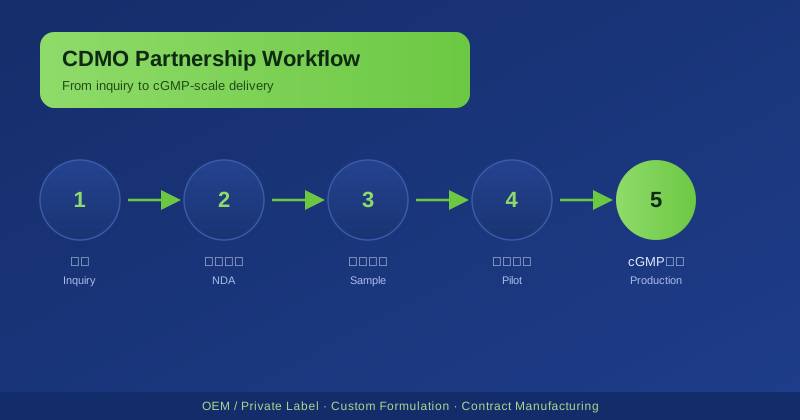
03 | What a full CDMO partnership actually looks like, step by step
Many brands approaching contract manufacturing for the first time don't actually know what happens between "first contact" and "first shipment."
Inquiry
Define ingredient, spec, target volume
NDA
Sign confidentiality, share formula details
Sample
Small-batch trial, confirm feasibility
Pilot scale-up
Verify stability at larger scale
cGMP production
Scheduled runs, QC, delivery
Steps 3 and 4 are where expectations most often go wrong — a formula that works at bench scale doesn't automatically scale to ton-level production. Many formulations behave well in the lab, then reveal impurity, stability, or cost issues once scaled to pilot volume.
That's why "do they have real pilot-scale-up experience" often matters more to a partnership's success than "how low is the quote."
04 | As the market matures, brands are getting pickier about CDMO selection
A couple of years ago, the questions brands asked when screening manufacturers were mostly about price and minimum order quantity.
The checklist has gotten longer.
| Evaluation dimension | What it looks like |
|---|---|
| Certifications | GMP, ISO credentials and third-party test reports on request |
| Format coverage | Powder, capsule, tablet, and custom blends handled by one partner |
| MOQ flexibility | Small validation batches supported, not just large minimums |
| Documentation | COA, MSDS, certificate of origin available per batch |
| Supply stability | Backed by owned production capacity, not ad-hoc outsourcing |
A longer checklist reflects a real shift in mindset — from "find a cheap factory" to "find a partner to build the product with, long-term."
05 | PathGene's take
As a company that both develops raw materials and offers contract manufacturing, we see brands increasingly favoring partners who already run stable production of the raw material itself, rather than pure white-label middlemen.
The reason is straightforward — when the manufacturer is also the ingredient producer, formula adjustments, cost control, and supply stability can all be resolved within one system, instead of being coordinated back and forth between a "supplier" and a "manufacturer."
What you should be looking for in a manufacturing partner isn't just a production line — it's someone accountable for the whole chain, from raw material to finished product.
PathGene Biotech is an innovative company focused on the R&D and industrial delivery of high-purity synthetic biology actives, spanning cellular longevity, energy metabolism, women's health, and natural actives. We offer OEM/private-label, custom formulation, and contract manufacturing for our flagship ingredients — NMN, NAD⁺, the NR series, S-Equol, and Citicoline — across capsule, tablet, and powder formats. To discuss a partnership, visit our CDMO services page or contact us for a quote.
Ready to evaluate our products?
Request a sample or send an inquiry — our R&D team responds within 24 hours.