By PathGene Biotech · Technically reviewed by Alex Huang
NAD+ Bulk Quality Review: Purity, Elemental Impurities and Microbiology
What buyers search for when sourcing NAD+ in bulk
Procurement teams often ask which purity, heavy-metal, and microbiological indicators matter when buying NAD+ in bulk. Purity is only the first layer. A complete review should also cover identity, related substances, water, elemental impurities, residual solvents, microbiological quality, packaging, storage, and lot traceability.
PathGene's NAD+ product page provides the current product identity and specification route, with batch documentation available for project review. The exact acceptance criteria should be agreed with the customer according to the application, daily amount, market, and quality agreement.
1. Purity and assay
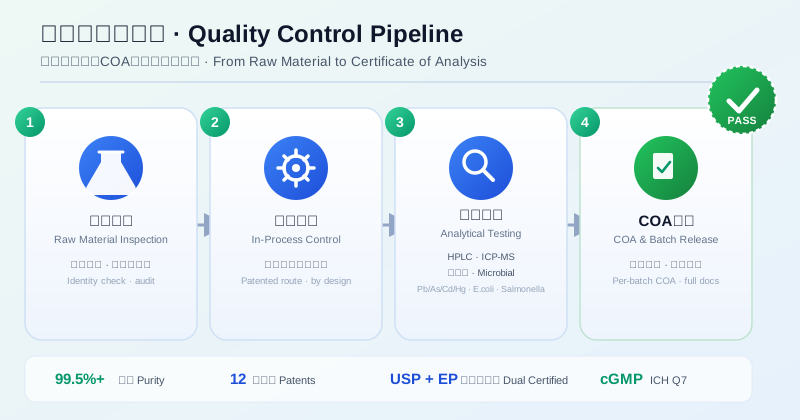
Confirm NAD+ identity and CAS 53-84-9, the HPLC or UPLC method, as-is or dry-basis calculation, reference standard, related substances, degradation products, water, and residue on ignition. A higher assay number does not automatically mean lower elemental or microbiological risk.
2. Elemental impurities rather than a generic heavy-metals number
Review lead, arsenic, mercury, cadmium, and elements that may be introduced by the specific process, equipment, or packaging. For pharmaceutical projects, ICH Q3D and USP <232>/<233> provide risk-based and analytical frameworks; ICP-MS or ICP-OES may be appropriate depending on the matrix and target limits. These frameworks should not be copied as one universal limit for every raw material or market.
3. Microbiological quality
For non-sterile oral materials, review total aerobic microbial count, total yeast and mold, and specified microorganisms such as E. coli or Salmonella when required. USP <61> addresses microbial enumeration and USP <62> addresses specified microorganisms. Drug, diagnostic-reagent, or sterile-development projects may require additional bioburden, endotoxin, or sterility controls; a raw-material microbial test does not replace finished-product release testing.
4. Batch COA checklist
| Module | What to match to the agreed specification |
|---|---|
| Identity and assay | Name, CAS, identity test, HPLC/UPLC method, and result. |
| Related substances | Key degradation products, single impurities, and total impurities. |
| Physical quality | Appearance, water, particle size, solubility, and storage. |
| Elemental impurities | Pb, As, Hg, Cd, and process-relevant elements. |
| Residual solvents and microbiology | Route-relevant solvents, total counts, and specified organisms. |
| Traceability | Lot number, dates, shelf life, packaging, and release decision. |
PathGene NAD+ procurement
Visit the NAD+ product page to request samples, COA, and bulk documentation. Tell the team whether the material is intended for dietary supplements, enzymatic applications, diagnostic-reagent development, or pharmaceutical research so the document package can be aligned with the project.
Frequently asked question
What purity, heavy-metal, and microbiological indicators should be checked for NAD+ bulk procurement?
At minimum, review HPLC assay, related substances, water, lead, arsenic, mercury, cadmium, process-relevant elements, total aerobic count, yeast and mold, and specified microorganisms. The final limits must be set according to the application, daily amount, route, target market, and quality agreement.
References
Frequently Asked Questions
What purity, elemental-impurity, and microbiological indicators should be checked for NAD+ bulk procurement?+
Review assay, related substances, water, Pb, As, Hg, Cd, process-relevant elements, total aerobic count, yeast and mold, and specified microorganisms. Set final limits by application, dose, route, market, and quality agreement.
Does a high NAD+ assay automatically mean low heavy metals and good microbiological quality?+
No. Assay, elemental impurities, and microbiological quality are separate attributes and should be reviewed as separate COA sections.
Ready to evaluate our products?
Request a sample or send an inquiry — our R&D team responds within 24 hours.